Last updated November 18, 2026








Free written scope consultation - allowances, timeline, and change-order rules on paper before a single trade is scheduled
Bathroom Remodeling Maintenance Schedule: What to Do and When
Most bathroom remodel warranties contain a clause that voids coverage if you fail to maintain the caulk joints. Almost no contractor hands you a maintenance schedule at closeout. That gap is expensive. In Miami’s humidity, a neglected caulk line at the tub deck becomes a soft substrate behind the tile within a couple of seasons, and the repair bill lands on you because the warranty explicitly excludes neglect. We’ve walked into Miami homes two years after a remodel where a $40 tube of sealant would have prevented $4,000 of substrate repair. This guide gives you the actual calendar: what to check at 30 days, what to do at six months, and what belongs on an annual list. It also explains how to document the work so you have standing if something fails.
Quick Answer
A bathroom remodel needs three maintenance checkpoints: a 30-day inspection (grout haze removal, caulk joint check, fixture fastener check), a 6-month service (re-caulk change-of-plane joints if needed, clean the exhaust fan), and annual tasks (grout sealing, showerhead descaling, valve cartridge check). Miami’s water hardness and ambient humidity make each of these more urgent than in drier climates. Following the schedule is what keeps most written workmanship guarantees in force.
Styles & brands we work with
- Kitchen remodeling
- Bathroom remodeling
- Home additions & ADU
- Roofing
- Windows & doors
- Driveway & pavers
- Fence
Table of Contents
- The 30-Day Inspection: What to Check First
- The 6-Month Service: Re-Caulk and Ventilation
- The Annual List: Sealing, Descaling, Valve Check
- Why Grout Type Changes the Sealing Math
- Miami-Specific Maintenance Factors
- Maintaining Warranty Conditions and Documenting It
- The Three Tasks That Cause 80% of Repair Calls
- Cleaning Products That Damage Porcelain and Stone
The 30-Day Inspection: What to Check First
Thirty days after a remodel closes, the bathroom has been through a full wet-dry cycle. Caulk has either bonded or it hasn’t. Grout haze that was invisible when the tile was wet at install has now cured into a film. Fixture fasteners have settled under normal use. This is the window where small corrections are free and cheap; six months later the same corrections involve removing tile.
Here’s the 30-day checklist, in the order we recommend:
- Grout haze removal. New grout releases a light mineral film on tile faces as it fully cures. Wipe with a damp microfiber cloth and a pH-neutral cleaner within the first 30 days, before the film bonds to the glaze. After 30 days the haze needs a specialty remover and more elbow grease.
- Caulk joint inspection. Run a fingernail along every caulk line at the tub deck, shower pan perimeter, backsplash edge, and vanity-to-wall seam. A properly bonded bead won’t lift. Any spot that peels away or shows a hairline gap needs re-caulking now, not later.
- Fixture fastener check. Grab the towel bars, toilet paper holder, shower valve trim, and vanity pulls. Loose fasteners after 30 days are normal settling. Loose fasteners after 6 months means the anchor wasn’t bedded in solid substrate.
- Drain and supply line check. Look for weeping fittings under the sink and behind the toilet. A drop on the cabinet floor is a call-back; a stain after six months is a subfloor repair.
- Exhaust fan airflow test. Hold a single square of toilet paper to the fan grille. If it doesn’t hold, the fan is clogged or undersized, and mold prevention in Miami depends on it working.
Document each item with a dated photo. That record matters more than most Miami homeowners realize; we’ll cover why under the warranty section.
The 6-Month Service: Re-Caulk and Ventilation
At six months, Miami’s humidity starts to reveal which caulk joints are actually sealed. The beads that survived the 30-day check can still develop microscopic separation at the change-of-plane joints, where two tile planes meet at an angle. Those joints flex. Rigid grout in a change-of-plane joint cracks; caulk handles the movement, but caulk also ages faster than grout in high humidity.
The 6-month task list:
- Inspect and re-caulk change-of-plane joints if needed. The interior corners of the shower, the tub-to-wall seam, the tile-to-drywall transition. If the caulk is pulling, chalky, or feels gummy, cut it out and replace it with a 100% silicone bath caulk. In Miami, silicone with active mold inhibitors holds longest.
- Clean the exhaust fan. Unclip the grille, soak it in warm soapy water, and vacuum the fan blades with a soft brush. A clogged fan pushes moisture back into the room, and that moisture is what feeds the mildew growth we regularly see behind Miami vanity mirrors.
- Test the toilet shut-off valve. Turn it fully closed and back open. Valves that sit untouched for years seize. A valve that won’t close when you need it becomes a flooded bathroom during a minor repair.
- Check the shower pan for standing water. Slope failures show up as a low spot pooling more than 1/8 inch of water. Standing water in a shower pan is a substrate risk, not a cosmetic issue.
- Wipe down cabinet interiors. Humidity inside a vanity cabinet traps moisture against the door frames. Wiping it every six months protects the finish and the frame.
If your 6-month inspection turns up soft substrate, bubbling paint on the ceiling below the bathroom, or a shower pan that’s pooling, those aren’t maintenance tasks. Those warrant a pro. A well-built bathroom from a bathroom remodeling in Miami project should not develop these in the first year.
The Annual List: Sealing, Descaling, Valve Check
Once a year, do the deeper service. These tasks are slower, and they protect the highest-ticket components in the room: the tile finish, the shower valve, and the fixture chrome. On a bathroom build we run through a general contractor in Miami standard that anticipates this annual list at design time – specifying a serviceable shower valve cartridge, for instance, so you can swap it without tearing apart the wall.
- Re-seal grout (only when the grout type calls for it). Cementitious grout benefits from a penetrating sealer every 12 to 24 months in Miami. Epoxy grout does not need sealing at all. We’ll break down the difference below.
- Descale the showerhead. South Florida water runs hard, and mineral deposits clog spray holes and accelerate corrosion at the threads. Unscrew the showerhead (use a cloth over the wrench so you don’t scratch the chrome), soak it in a 50/50 white vinegar and water solution for an hour, and scrub the holes with a soft brush. Do the same for the faucet aerator.
- Inspect the valve cartridge. Run the shower at full hot and full cold for a minute each. If temperature drifts, if the handle feels gritty, or if the water pressure seems off, the cartridge is wearing. Catching it early means a $40 cartridge swap; catching it late means a rough-in repair inside the wall.
- Check the toilet flapper and supply line. A flapper that doesn’t seal wastes water every hour. A braided supply line that shows corrosion at the fittings is a $15 replacement that prevents a much bigger bill.
- Recheck every caulk joint you replaced at the 6-month mark. Annual re-inspection is part of the schedule, not a sign of failure.
If your bathroom includes natural stone (marble, travertine, limestone), the annual seal is more frequent: every 6 to 12 months depending on traffic, and always with a stone-specific sealer, never a grout sealer.
Why Grout Type Changes the Sealing Math
Every “how often should I seal my grout” answer you see online assumes cementitious grout. It’s only half the answer. Here’s the breakdown by grout type:
- Sanded grout. Standard choice for floor tile and grout lines 1/8 inch or wider. Sanded grout is porous and stains. Penetrating sealer every 12 to 24 months in Miami. The sand particles make it rough, so sponge a sealer on, let it soak, and wipe the excess with a dry cloth.
- Unsanded grout. Used in thin grout lines (under 1/8 inch), typically wall tile and shower walls. Also porous, also needs sealing – but the smooth surface makes application easier. Annual sealing is reasonable for showers in a Miami bathroom.
- Epoxy grout. Mixed from a two-part epoxy resin. Doesn’t absorb water, doesn’t stain, doesn’t mildew at the grout line the way cementitious grout does. Epoxy grout does not need sealing. Ever. If your bathroom was built with epoxy in the shower, the only maintenance that applies is cleaning – and that’s the point. Epoxy is worth the upcharge in a humid, high-traffic shower.
If you don’t know which grout you have, this is the conversation to have with the original installer. In our work, we document the grout spec at closeout for exactly this reason. If you’re planning a remodel soon, the grout choice is one of a set of spec decisions the trades make before tile goes down. See the kitchen remodeling in Miami guide for a similar breakdown on backsplash and counter sealants.
Miami-Specific Maintenance Factors
Maintenance schedules written for the Midwest underestimate what a Miami bathroom endures. Three factors make each task more urgent here:
- Water hardness. Miami-Dade municipal water carries a noticeable mineral load. Showerheads, faucet aerators, and glass shower panels accumulate crust faster than in most U.S. metros. Descale showerheads every 6 months, not annually. Glass shower doors benefit from a squeegee after every use.
- Ambient humidity. Miami’s average humidity hovers above 70% much of the year. Behind a shower curtain or an unvented bathroom door, that humidity stays trapped. Exhaust fans become a mold-prevention system rather than a comfort feature. Run the fan 20 minutes after every shower.
- Salt air and coastal corrosion. Homes in neighborhoods like Coconut Grove, Miami Beach, and Key Biscayne see accelerated corrosion on chrome fixtures and grout hardware. Rinse fixtures with plain water and dry frequently; skip abrasive cleaners that strip the protective finish.
The mildew problem is the one that catches most homeowners off guard. Mildew likes to start where water sits: the bottom corner of the shower door track, the seal at the tub deck, the base of a glass shower panel. Wipe those dry after every shower. If you see a speck of black within 2 to 3 days of a fresh bathroom remodel, treat it immediately with a mildew-specific cleaner and inspect the caulk. That’s the point where a free two-minute fix prevents a warranty question at year two.
For our part, we work from the Bradford Remodeling Co Miami home standard that anticipates all three of these factors at design time. Extractor fan sizing, moisture-resistant drywall (greenboard or cement backer board behind tile), and epoxy grout in wet zones are the design decisions that reduce what the schedule has to catch later.
Maintaining Warranty Conditions and Documenting It
Here’s where most homeowners get caught. A workmanship warranty covers defects in the installation. It does not cover neglect. When a warranty says “will be free of defects in materials and workmanship,” the fine print usually carves out failures caused by the homeowner failing to perform ordinary maintenance. Whether the manufacturer or the installer enforces that clause depends on what the homeowner can show.
What “maintaining warranty conditions” actually means: the homeowner follows the ordinary maintenance steps the trade standards call for, and can show proof. Keep it simple:
- Photograph each maintenance checkpoint with a date stamp. Your phone does this by default. A dated photo of the shower caulk joint at 6 months is evidence. Nothing more is required.
- Keep your receipts for sealers and caulks. Prove the products were purchased and applied.
- Log any service call. If a technician sees your bathroom, write down the date and what was done.
- Report defects promptly. If you spot a failure – soft spot, mold, sagging – call the original contractor inside the warranty window. Delay weakens the claim; prompt notice is your clearest evidence of good faith.
Bradford Remodeling’s 365-Day Done Right Promise is a straightforward written guarantee: for a full year after project close, if the work fails, we return and correct it at no charge. What makes that promise enforceable in practice is documentation on both sides – ours at closeout and yours through the year. Save the schedule. Save the photos. If we ever need to make good on the promise, the record protects both of us.
The Three Tasks That Cause 80% of Repair Calls
In our experience across Miami, most post-remodel bathroom repair calls trace back to the same three skipped tasks. Handle these three and you avoid the bulk of the problems:
- Skipping caulk-joint re-caulking when the joint separates. A failed change-of-plane joint lets shower water wick behind the tile. That water sits in the substrate, and six months later you’re looking at soft cement board, failed thinset, and a partial tear-out. Cost in Miami: typically $400 to $900 if caught at the first sign; well over $2,000 once the substrate has failed.
- Letting the exhaust fan run without cleaning. A clogged fan stops pulling moisture. Mildew takes hold behind the mirror, above the shower door, and on the ceiling. Remediation and repaint: $300 to $700 depending on the extent. Replacing the fan: under $150.
- Never descaling the showerhead and faucet aerator. Miami water deposits clog the flow holes; corrosion pits the threads. A seized shower arm inside the wall becomes a plumbing repair, not a fixture swap. Descaling takes 15 minutes and costs a bottle of vinegar. Replacing a fixture with a stuck arm: $180 to $350.
The pattern holds whether your bathroom is in Coral Gables, Brickell, or a 1960s ranch home in Westchester. Maintenance beat the schedule, repairs show up. Follow the schedule, and the phone stays quiet.
Cleaning Products That Damage Porcelain and Stone
The wrong cleaner can undo a year of careful maintenance in one scrub. Two categories rule this:
- Abrasive powders and creams. Ajax, Comet, and other scouring powders scratch glazed porcelain and polished stone. Once the glaze is scratched, dirt and mildew cling to the scratches and never fully clean out. Use non-abrasive cream cleaners with a soft cloth.
- Acidic cleaners on natural stone. Vinegar, citrus-based cleaners, and bathroom cleaners with acidic additives etch marble, travertine, and limestone. Use a stone-specific pH-neutral cleaner, and never a bathroom cleaner labeled “limestone-safe” unless the label actually says so. On porcelain tile, mild acid is fine; on natural stone, it is not.
Keep it simple: a pH-neutral bathroom cleaner for glazed porcelain and grout, a stone-specific cleaner for any marble or travertine, and a soft microfiber cloth. Avoid bleach on epoxy grout; it dulls the surface. Chlorine-based cleaners wear down caulk faster than silicone-safe alternatives. Consistent mild cleaning beats aggressive scrubbing every time.
Common Mistakes to Avoid
- Re-caulking over old caulk. New caulk doesn’t bond to cured silicone. Cut the old bead out with a utility knife, clean the joint with isopropyl alcohol, and let it dry fully before applying the new bead. Layering is the single most common cause of a caulk failure we get called back for.
- Using the wrong sealer on natural stone. Grout sealer and stone sealer aren’t the same product. Stone sealer is formulated to penetrate without altering color; grout sealer can dull or stain marble. In Miami homes with marble bathrooms, this is the mistake we see most.
- Neglecting the exhaust fan in an interior bathroom. A windowless bathroom in a humid climate without an operating fan is a mildew chamber. Test the fan monthly, clean it at six months. If it fails, replace it.
- Skipping the annual valve cartridge check. Ignoring a gritty handle or temperature drift means waiting for the cartridge to fail. When a cartridge fails, the water often needs to be shut off at the main – a $40 service becomes an emergency.
- Documentation neglect. A homeowner who can’t produce a dated photo of the caulk at 6 months has a weaker warranty position than one who can. The fifteen seconds it takes to snap a photo matters more than it feels like it does.
- Cleaning with bleach on epoxy grout. Epoxy grout is chemically tough but cosmetically vulnerable to chlorine. It dulls over time and can fade. Use a pH-neutral cleaner and reserve bleach for the toilet bowl.
- Assuming the schedule ends at year one. The maintenance calendar runs for the life of the bathroom. Grout re-sealing, showerhead descaling, and the valve check belong on your annual calendar, not your move-out checklist.
See the difference
 Before
 After
 Before
 After
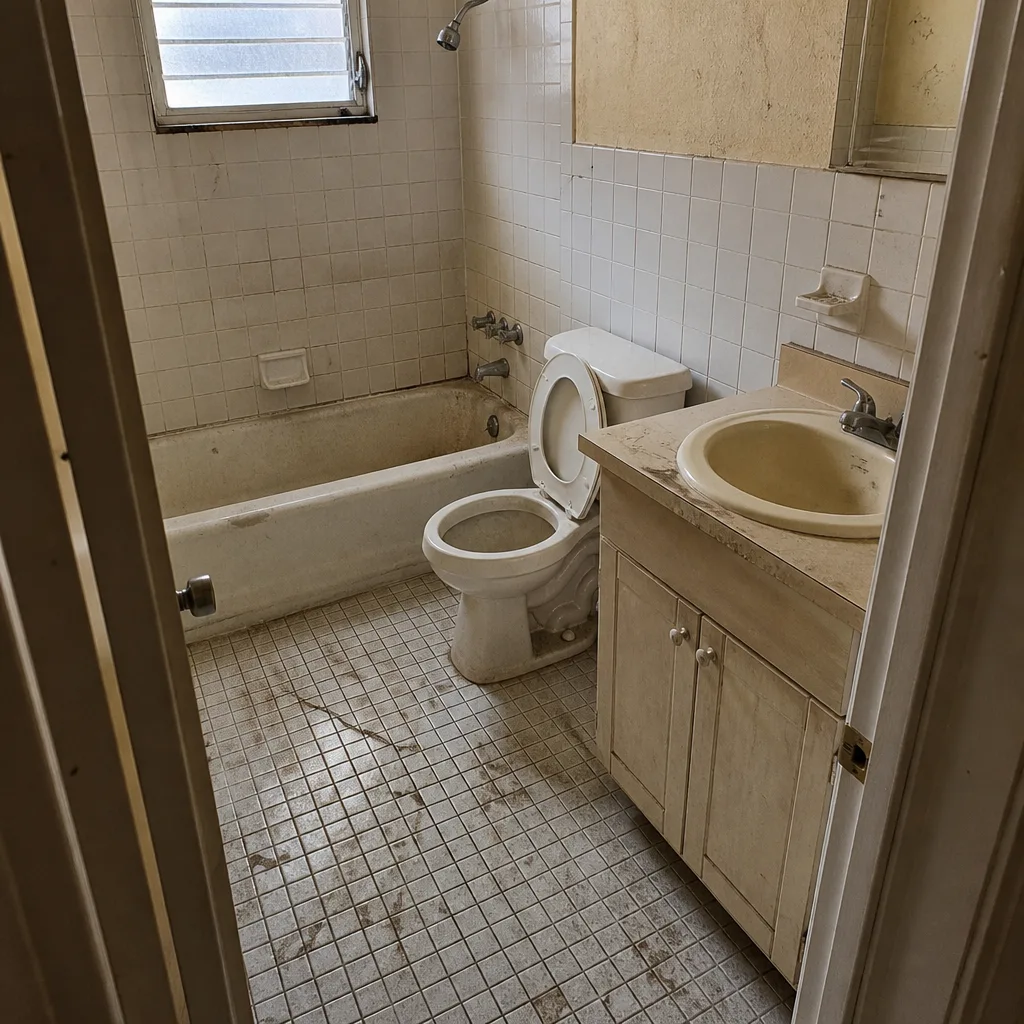 Before
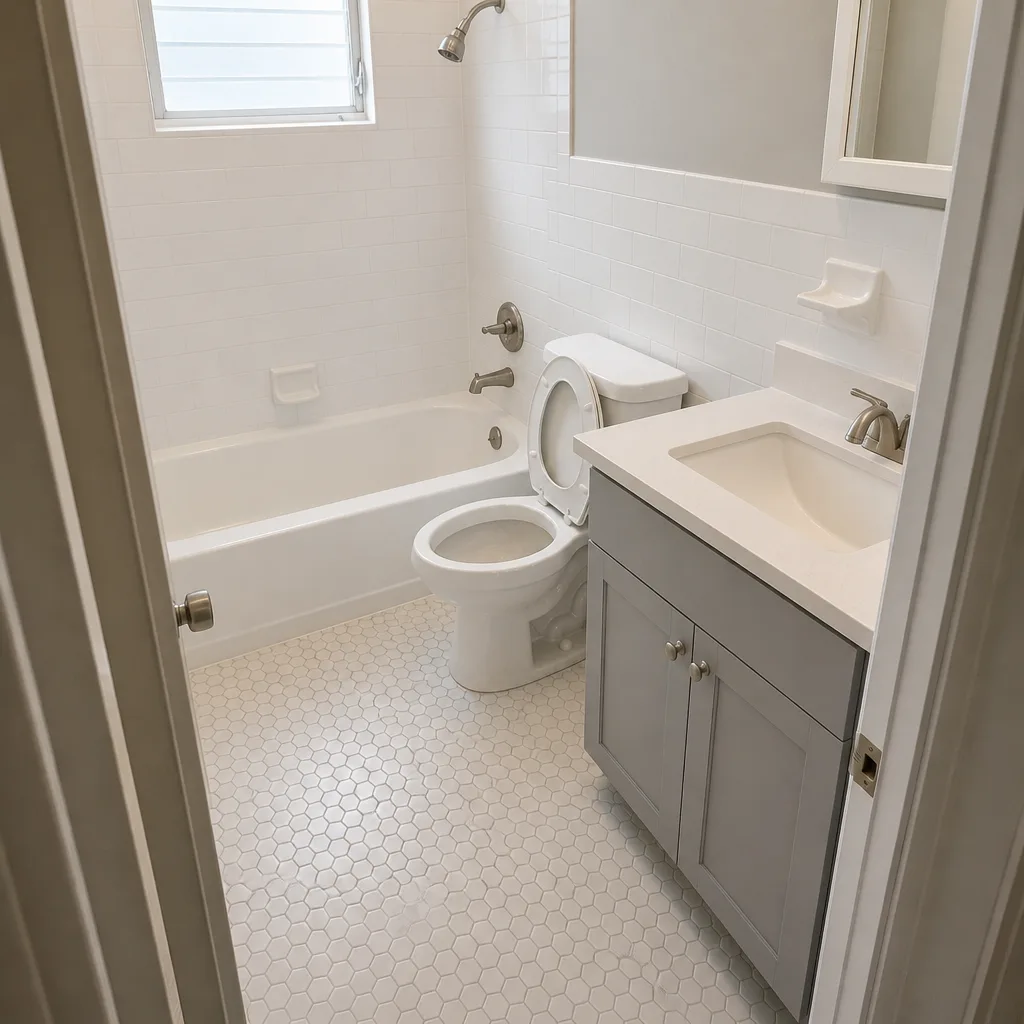 After
When to Call a Professional
Most items in this schedule are homeowner tasks. A few aren’t, and calling them wrong is expensive. Call a professional when you see: soft or spongy substrate behind tile (press on the wall; if it gives, water has been getting in), mold that returns within two weeks of cleaning, a shower pan that pools water or slopes wrong, a valve cartridge that’s seized inside the rough-in, or a ceiling below the bathroom that shows water stains or bubbling paint. Those aren’t maintenance items. They’re signs the installation or the plumbing needs a qualified hand.
For a repair or an original project built to a spec that anticipates Miami’s conditions, Bradford Remodeling Co Miami offers free estimates – a written price range in your hand before any work starts, backed by the 365-Day Done Right Promise on completed work. Call (844) 797-4435 and a live person answers, day or night. No voicemail, no callback queue.
Frequently Asked Questions
Cementitious grout – both sanded and unsanded – needs penetrating sealer every 12 to 24 months in Miami, with annual sealing recommended for shower walls. Epoxy grout never needs sealing at all. If your shower was built with epoxy, skip this task entirely and focus on keeping the joints clean.
Plan to inspect caulk joints at 30 days and 6 months, and expect a full re-caulk of the change-of-plane joints every 2 to 3 years in a humid bathroom. A high-traffic shower with a daily user may need it sooner. If a bead pulls away from the tile with a light fingernail test, re-caulk now – don’t wait for the next scheduled checkpoint.
It can. Most written workmanship guarantees cover defects in installation and materials, and exclude failures caused by homeowner neglect. The clause is enforceable only if the installer can show the neglect. Keeping dated photos of your caulk joints and sealer applications is your standing. The 365-Day Done Right Promise covers workmanship defects for a full year; ordinary maintenance is what keeps that coverage working.
Ambient humidity above 70% for much of the year, combined with interior bathrooms and unvented spaces, creates the perfect environment for mildew. The fix is airflow and drying: run the exhaust fan for 20 minutes after every shower, wipe down glass and caulk seams after use, and clean the fan grille every 6 months. Persistent mildew returning within two weeks of cleaning is a sign of an underlying moisture problem, not a cleaning problem.
Epoxy grout does not need sealing and does not stain or mildew the way cementitious grout does, but it isn’t truly maintenance-free. It needs regular cleaning with a pH-neutral product, and it can dull if exposed to bleach or harsh acids. Sodium-safe cleaners only, and no scrubbing pads that scratch the surface. For a humid Miami shower, the lack of re-sealing is the main benefit.
Replacing a shower valve cartridge is a plumbing task, not a homeowner task, and it should be done by a licensed plumber or a contractor’s trade partner. The rough-in inside the wall carries significant water pressure, and getting it wrong floods a wall in minutes. Your job is to check the handle annually and call if you feel grit or temperature drift; leave the swap to the trade.
The Bottom Line
A bathroom remodel is a 15-year asset that stays intact when you follow a calendar: the 30-day inspection, the 6-month re-caulk and fan service, and the annual seal, descale, and valve check. Miami’s hard water and humidity make every checkpoint more important than in drier markets, and the documentation habit is what protects your warranty standing if a defect surfaces at year two. Handle the three high-value tasks – caulk joints, exhaust fan, showerhead descaling – and you avoid the bulk of post-remodel repair calls. Bradford Remodeling Co Miami builds bathroom remodels to that standard, backs them with The Garrison Standard and the written 365-Day Done Right Promise, and gives you a written price before work begins.
Written by the team at Bradford Remodeling Co Miami.
Ready to build a bathroom you won’t spend the next year patching? Call (844) 797-4435 for a free estimate, or to ask about the maintenance spec we build into every project.