Last updated November 18, 2026




Free written scope consultation - allowances, timeline, and change-order rules on paper before a single trade is scheduled
DIY vs Professional Kitchen Remodeling: What’s Safe to Do Yourself
Painting your own kitchen cabinets after a professional install sounds simple enough. But if you paint before the countertop template appointment, you can contaminate the template surface, and the stone gets cut to the painted dimension instead of the cabinet dimension. That quarter-inch error doesn’t show up until the slab is on the truck. In a kitchen remodel, the DIY-versus-professional split isn’t really a skills question. It’s a sequencing question. Doing the wrong task yourself at the wrong point in the project can invalidate the trades behind you, break a subcontractor’s workmanship warranty, or void your permit. This guide maps which kitchen tasks a Miami owner-builder can self-perform without breaking the professional sequence, and which ones will cost more than they save.
Quick Answer
In a Miami kitchen remodel, you can safely self-perform finish work that happens after rough-in and inspection: painting, hardware and pulls, open shelving, backsplash tile on a sound substrate, and final caulking. You should not self-perform anything that touches structure, plumbing, gas, or electrical: soffit removal near a load-bearing wall, moving a drain line, running a new circuit, or relocating a gas range. The line isn’t about courage or YouTube confidence. It’s about which tasks sit inside the permit and which trades your work would invalidate.
Styles & brands we work with
- Kitchen remodeling
- Bathroom remodeling
- Home additions & ADU
- Roofing
- Windows & doors
- Driveway & pavers
- Fence
Table of Contents
- Why Sequencing Matters More Than Skill
- Kitchen Tasks You Can Genuinely Do Yourself in Florida
- Where Demo Is Safe and Where It Isn’t
- Coordinating Owner-Supplied Finish Work Around the Contractor’s Schedule
- The Real Cost Math: When DIY Saves and When It Backfires
- Miami-Specific Constraints: Permits, Humidity, and Inspection Timing
- What Our Written Contract Says About Owner-Performed Work
- Common Mistakes to Avoid
- When to Call a Professional
Why Sequencing Matters More Than Skill
A kitchen remodel runs on a sequence, and that sequence is not arbitrary. It exists because each trade leaves behind a surface, a measurement, or an inspection that the next trade depends on. Break the order and you don’t just lose time. You lose the warranty on the work behind you.
Here’s the rough order a Miami kitchen follows. Demolition. Rough plumbing and electrical. Rough-in inspection. Insulation and drywall. Cabinet install. Countertop template. Countertop fabrication and install. Backsplash. Appliance and fixture set. Final inspection. Punch list.
Owner-performed work is safest in the last three stages, after the trades that require inspection have signed off. Everything before the cabinet install is a minefield for a homeowner who wants to help. The reason is simple: once a licensed plumber roughs in a drain and the inspector signs it, that plumber’s workmanship warranty is attached to a specific configuration. If you move the cabinet line eighteen inches and the drain no longer lines up, the plumber isn’t responsible for the change. You are.
There’s a second layer most homeowners miss. Cabinet warranties from manufacturers like KraftMaid and Wellborn are written against the installed configuration. If a homeowner modifies the cabinet boxes, cuts into the back for a homeowner-run pipe, or paints over the factory finish, that warranty doesn’t cover the result. We see this in Miami condos where an owner decides to “just” trim the back of a sink base to fit a deeper basin. That trim voids the cabinet box warranty and can void the countertop template, because the template was taken before the trim.
Skill gets you a clean paint line. Sequencing gets you a kitchen that passes inspection and holds up. The best interior painter in the world can still wreck a remodel by painting two weeks early.
Kitchen Tasks You Can Genuinely Do Yourself in Florida
Florida’s owner-builder rules do allow a homeowner to pull a permit for their own primary residence, but most kitchen remodels in Miami aren’t run that way because of the inspection coordination involved. In practice, what a homeowner can self-perform without touching the permit are the finish tasks below.
These are the tasks we see homeowners successfully handle:
- Interior painting after the drywall is finished, primed, and inspected. Not before.
- Cabinet hardware and pulls on factory boxes, using a drilling jig so the spacing is consistent. This is the single highest-value DIY task in a kitchen, because a jig costs less than $30 and a professional charge to install forty pulls runs a few hundred dollars.
- Open shelving in drywall, anchored to studs with the correct fasteners. Not into tile, and not into a wall where plumbing runs behind.
- Final caulking along the backsplash-to-wall line and behind the sink, using a mold-resistant silicone rated for wet areas. Miami’s humidity makes this one worth doing right, because cheap caulk grows mildew in a year.
- Backsplash tile on a flat, sound substrate, if you’ve tiled before and the tile is a standard ceramic or porcelain. Not on a wall the electrician needs to cut into for an outlet relocation.
- Appliance delivery coordination and unpacking, though most homeowners should let the installer handle the actual hookup for anything gas or hardwired.
What these tasks share: they happen after the permit-driven work is closed, they don’t touch structure, plumbing, gas, or electrical, and they don’t affect a warranty on any installed component. That’s the test. If a task passes all three, it’s DIY-safe in practical terms.
Where Demo Is Safe and Where It Isn’t
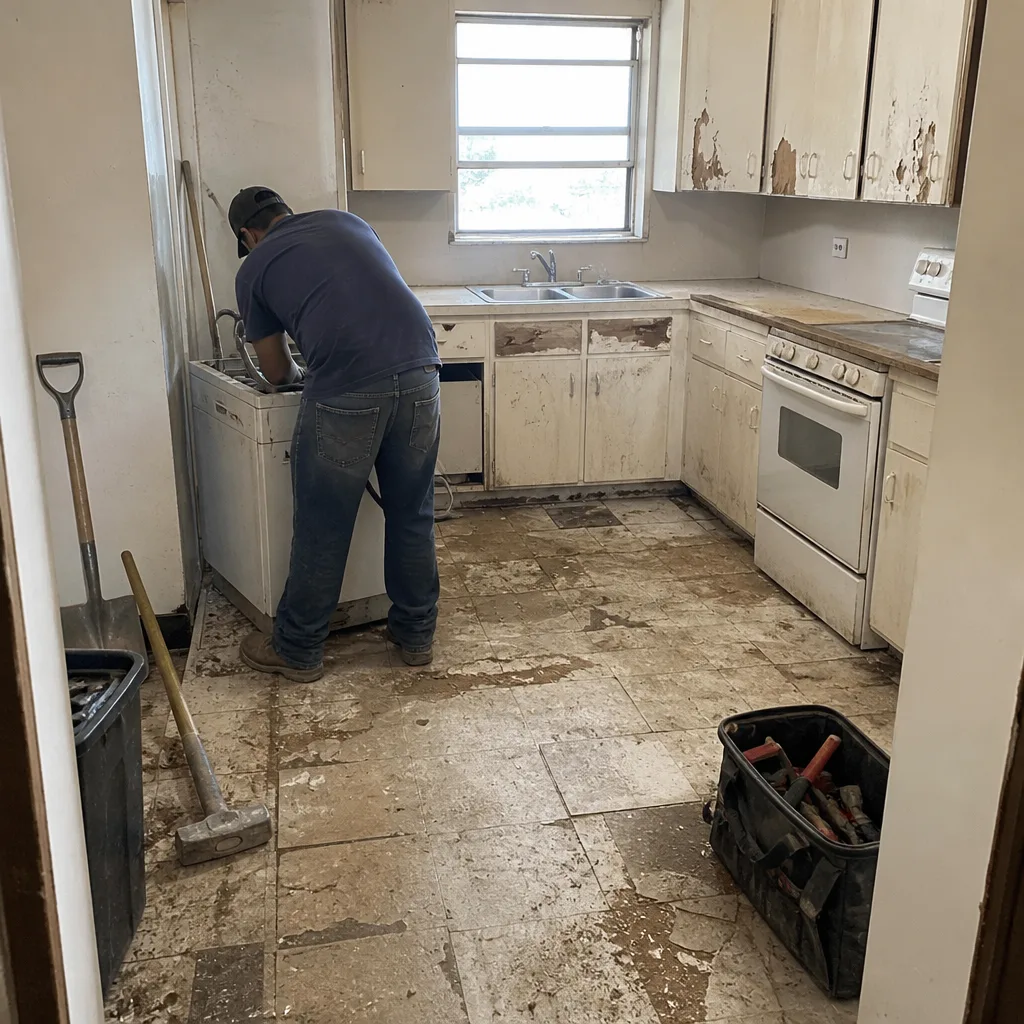
Demo feels safe because it’s destructive. The reality is the opposite: demo is the highest-risk part of a kitchen remodel for a homeowner, because what you break may be holding up the house.
Safe demo in a Miami kitchen is limited to:
- Removing cabinet doors and drawers you know are not attached to anything structural.
- Pulling appliances that are disconnected at the shutoff and the breaker.
- Removing non-structural finishes: old laminate countertops, backsplash tile, vinyl flooring.
- Taking down upper cabinets that are screwed into drywall or into the cabinet run, not into a soffit.
Where demo is genuinely unsafe:
- Soffits. A soffit above the kitchen cabinets can be structural or can hide ductwork, and in older Miami homes it may also hide a chase for plumbing or wiring. You won’t know which until you look inside. If the soffit is load-bearing or contains a chase, cutting it is the difference between a cosmetic project and a structural repair. That’s a licensed professional’s call, not a homeowner’s.
- Plumbing chases. A chase behind the wall is a cavity that carries a stack or a drain line. Puncturing it isn’t just a leak. It’s a sudden flood in a Miami condo that can hit the unit below and bring the association into the project.
- Anything near the electrical panel or a gas line. Moving a gas range line requires a licensed plumber in Miami-Dade, and running a new circuit for a wall oven requires a licensed electrician and an inspection.
- Walls around windows, especially in high-rise condos. Window systems like ES Windows and CWS are installed to specific rough-opening dimensions, and cutting into the wall around them can compromise the flashing and the impact rating.
The rule we give homeowners: take down what you can see is not structural, and stop the moment you hit something you can’t identify. That’s not a failure. That’s the right instinct.
Coordinating Owner-Supplied Finish Work Around the Contractor’s Schedule
This is where most DIY plans actually fall apart. The homeowner has every intention of painting, but the paint happens in the wrong week, or the hardware install happens before the countertop template, and now the schedule is in a fight with itself.
Here’s the sequence that keeps liability clear. Follow it in order:
- Cabinet install is complete and the countertop template is taken. Do not paint cabinets or install hardware before the template.
- Countertop is fabricated and installed. Nothing owner-supplied happens between template and slab install, because the fabricator is measuring and cutting to the cabinet configuration exactly as they saw it.
- Backsplash and appliance set. These belong in the contractor’s scope, because a backsplash behind a slide-in range needs to be level with the range cutout, and appliance hookups need to be coordinated.
- Owner-supplied final painting and hardware install. Now the surfaces are stable and the template is done.
- Owner-supplied open shelving and final caulk. Last of all, after the appliances are set and the outlets are trimmed.
The one place this breaks down most often is a cabinet paint project. Homeowners decide to paint cabinets a new color and assume the countertop template happens after. If the paint is applied before the template and the drying time isn’t factored in, the fabricator’s template is taken against a surface that will shift once the paint cures. The result is a slab that fits the painted dimension, not the cabinet dimension. That’s a callback that costs more than the paint job saved.
One more point about the schedule: if you plan to supply your own materials, tell your contractor before the contract is signed. If you plan to supply your own fixtures, tell them at the specification stage, not after the plumber has already ordered. Kohler and Moen fixtures have specific rough-in dimensions, and a substituted fixture after rough-in can require a re-do of the plumbing work.
The Real Cost Math: When DIY Saves and When It Backfires
The math is not “labor rate times hours.” It’s “labor rate times hours, minus the value of the warranty you gave up.” Here’s what that looks like in real Miami numbers.
Typical savings from self-performing finish work in a Miami kitchen:
- Interior kitchen painting: professional cost runs $800 to $2,400 for a mid-size kitchen with ceiling; DIY paint and materials run $150 to $400. Savings roughly $500 to $2,000.
- Cabinet hardware install (40 pulls): professional cost $250 to $500; DIY with a jig about $30 plus hardware. Savings roughly $220 to $470.
- Backsplash tile on a small area: professional cost $600 to $1,800; DIY materials $200 to $600. Savings roughly $400 to $1,200.
- Final caulking: professional cost $150 to $350; DIY $25 in materials. Savings roughly $125 to $325.
Typical cost of DIY where it backfires:
- Cabinet repaint done before template, causing a countertop refabrication: $900 to $2,800 for the slab, plus a new template fee.
- Wrong-size hole for a sink cutout after a homeowner-supplied basin was spec’d late: $400 to $1,200 to correct the slab or replace it.
- Backsplash tile installed before outlet relocation: $300 to $700 to remove tile, cut, reroute, and retile.
- Soffit demo that turns out to be load-bearing or to hide a chase: $1,800 to $6,000 for structural repair, plus a permit amendment.
- Water damage from a nail or a plumbing chase puncture in a condo: potentially into five figures once the unit below and the association are involved.
The math is clear. Finish work saves real money when done in the right window. Demo and rough-in work saves almost nothing and can multiply the cost of the project. If the DIY task is one you can undo with a return trip to the store, do it. If it’s one that requires a permit amendment to fix, hire it out.
Miami-Specific Constraints: Permits, Humidity, and Inspection Timing
Miami-Dade runs a real permit and inspection process on kitchen remodels, and the process is what makes DIY coordination different here than in a lot of the country. The permit is tied to a scope, and the scope is tied to an inspection sequence.
What that means in practical terms:
- Owner-builder permits exist but carry real responsibility. A homeowner can pull a permit for their own primary residence, but the homeowner is then the person responsible for the inspection schedule, the corrections, and any special inspection the county requires. In a condo or high-rise, the association usually requires a licensed contractor and proof of insurance before work starts, which closes the owner-builder route for most Miami kitchens.
- Rough-in inspection has to happen before drywall. If a homeowner decides to close up a wall themselves after rough-in, the inspector may require the wall to be opened again. That’s a cost you don’t get back.
- Humidity affects finish timing. Miami humidity slows paint and caulk cure times, and a kitchen without cabinets or a working HVAC holds the moisture longer. If you’re painting cabinets in a kitchen where the cabinet doors are detached and drying in a garage, factor in the humidity and don’t rush reinstall. A door reinstalled before the paint has fully cured will stick.
- High-rise windows and walls. Window systems like ECO Window Systems, ES Windows, and CWS are installed to impact-rated rough openings and specific flashing details. Cutting or modifying the wall around them can void the impact rating and the association’s approval. That’s not a DIY boundary you want to test.
- Association rules. Most Miami condo associations require approval for any interior work involving plumbing or electrical, and they require contractor insurance certificates before work begins. A homeowner planning to self-perform a task that touches either should get the association’s approval in writing before starting.
The humidity point deserves a second mention for a reason. We’ve seen homeowner-painted cabinet doors reinstalled the next day, and by week two the doors don’t sit flush. That’s a $300 mistake that costs $1,200 to correct. Wait for full cure. Seven days for painted cabinet doors in Miami is not excessive.
What Our Written Contract Says About Owner-Performed Work
Every Bradford Remodeling Co Miami project starts with a written price before any work begins, and that written scope specifies what owner-performed work is permitted, what voids coverage, and how scope changes get documented. That’s part of The Garrison Standard, and it’s not negotiable on our jobs.
Here’s what the contract addresses, in plain terms:
- Permitted owner work. Finish painting after template, hardware install, open shelving, final caulking, and similar post-inspection finish tasks are written into the scope as owner-performed, with a defined start date.
- What voids the 365-Day Done Right Promise. Any owner modification to installed components voids our guarantee on those components. If the homeowner re-drills the cabinet box, trims a countertop, or re-cuts a backsplash around a relocated outlet, that work is no longer covered by our guarantee. The rest of the project stays covered. The 365-Day Done Right Promise runs a full year from project completion, and if the work we installed fails inside that window, we come back and correct it at no charge. Owner-modification of an installed component is the main carve-out.
- Scope change documentation. Any change to installed scope, including a homeowner decision to add a task mid-project, is documented in a written change order before work continues. The written price for that change is agreed before the tool is picked up. No numbers that move at the door.
- Who is on site. Background-checked, uniformed technicians on every job, with the identity of the crew set at the Garrison Partners level, not left to individual job sites.
- Inspection ownership. We pull the permits and we own the inspection schedule. If a homeowner-performed task falls in the inspection path, our project manager will document it in writing before it happens.
We build this into the contract because we’ve seen what happens without it. A homeowner says “I’ll handle the backsplash,” the backsplash gets installed before outlet relocation, and now the electrician wants a re-cut, the tile setter wants a re-do, and nobody agrees on who pays. With a written scope, that conversation happens before the work, not after.
Our technicians carry up to 22 years of experience, and the roster of materials is documented from the start: KraftMaid and Wellborn cabinets, Cambria, Silestone, and Caesarstone surfaces, Kohler and Moen fixtures, GAF and CertainTeed roofing products, James Hardie siding, Therma-Tru doors. That matters to the DIY plan because every manufacturer’s warranty has its own terms about owner modifications. We can tell you exactly which ones you’d be voiding. If your kitchen plans also involve other rooms, we also handle bathroom remodeling in Miami and full general contractor services in Miami with the same written scope discipline.
Common Mistakes to Avoid
- Painting cabinets before the countertop template. The template is taken against the surface as it exists at that moment. Paint first and the slab gets cut to a dimension that will shift. Wait until the countertop is installed.
- Removing a soffit without an inspection. In a Miami kitchen, a soffit can be structural or can hide a plumbing chase. Take a look inside with a small inspection hole before you swing a hammer, and stop if you find anything structural or wet.
- Installing backsplash before outlet relocation. If the electrician still needs to cut a box into that wall, the tile work is in the way. Backsplash goes after electrical trim.
- Supplying a fixture after rough-in. A Kohler or Moen faucet spec’d late can require a re-do of the plumber’s rough-in. Pick the fixture before the rough-in starts.
- Cheap caulk in a Miami bathroom-adjacent kitchen. Standard painters’ caulk grows mildew in a humid Miami summer. Use a mold-resistant silicone rated for wet areas.
- Assuming condo association approval isn’t needed. Most Miami associations require interior work approval for plumbing or electrical and require insurance certificates from contractors. Get approval in writing before work starts.
- Reinstalling painted cabinet doors the next day. Miami humidity slows cure time. Reinstall a painted door before the paint has fully cured and it will stick. Seven days is a reasonable minimum.
When to Call a Professional
Call a licensed professional for anything that touches structure, plumbing, gas, or electrical, and for anything inside the permit. That includes soffit removal, any change to a plumbing chase, moving a gas range line, adding an outlet or a dedicated circuit, cabinet install, countertop template and fabrication, and any window or wall work near an impact-rated window system. It also includes permits and inspections, which in most Miami condos require a licensed contractor anyway.
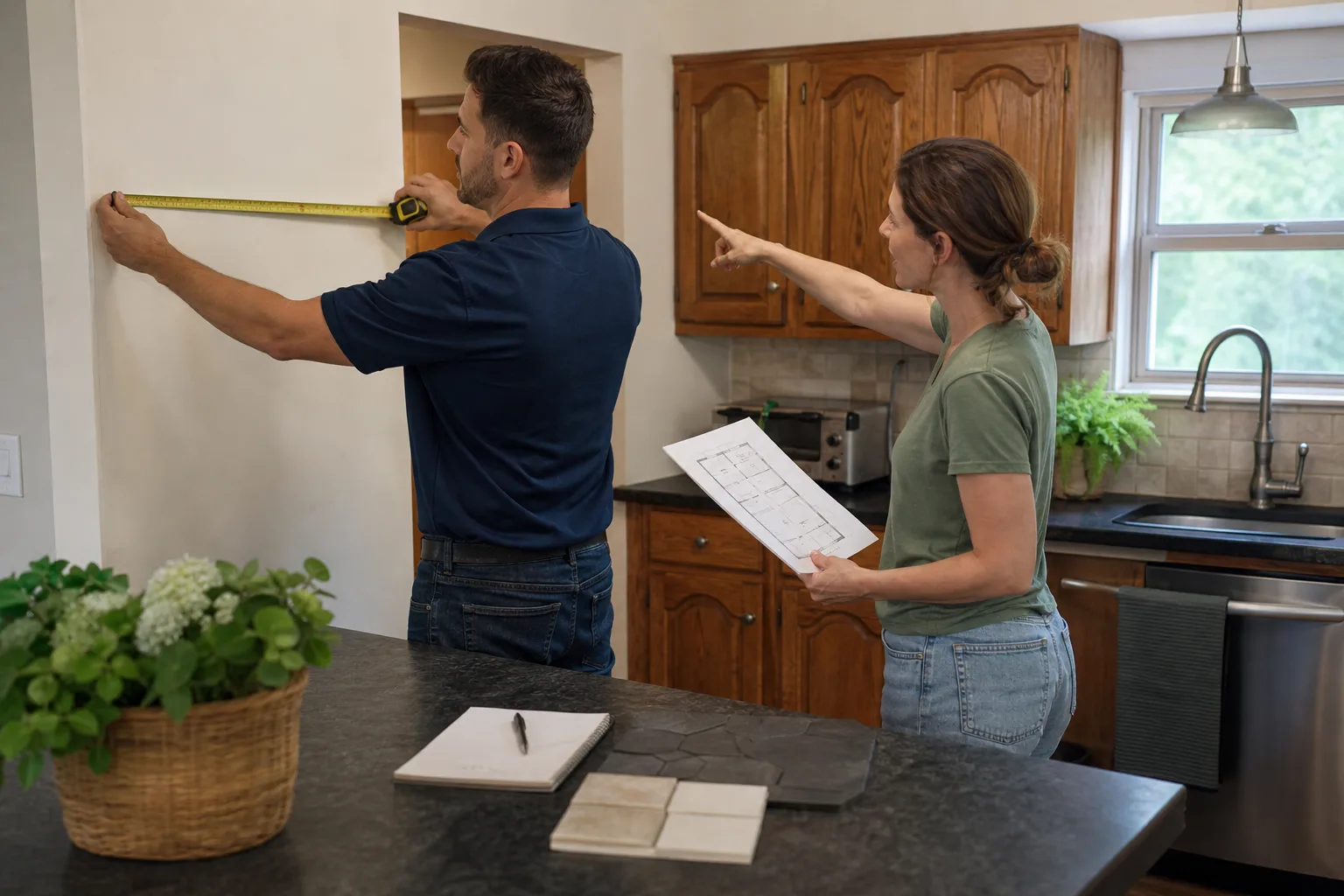
Call us before you start, not after. Bradford Remodeling Co Miami offers free estimates in Miami with a written price before any work begins. Call (844) 797-4435 and we’ll walk your project scope with you, including which finish tasks you can handle yourself and which ones we need to keep inside our warranty. Live person answers the phone, day or night.
See the difference
 Before
 After
 Before
 After
 Before
 After
Frequently Asked Questions

Finish work that happens after the countertop is installed and after inspection: interior painting, cabinet hardware install with a drilling jig, open shelving in drywall, backsplash tile on a sound substrate, and final caulking. Anything that touches structure, plumbing, gas, electrical, or the permit stays with a licensed professional. The dividing line is whether the task modifies an installed component or sits inside the inspection sequence.
Yes, but only after the countertop template has been taken and the slab is installed, and only if you wait for full cure before reinstalling doors. In Miami humidity, seven days is a reasonable minimum. Painting before the template can contaminate the template surface and produce a countertop cut to the painted dimension rather than the cabinet dimension. Call (844) 797-4435 if you want us to sequence this into your project scope in writing.
Owner modification of an installed component voids the contractor’s guarantee on that component. Under our 365-Day Done Right Promise, if the work we installed fails within a full year of completion, we come back and correct it at no charge. If you modify that component, our guarantee on it no longer applies. The rest of the project stays covered. The written scope in our contract is specific about this before work starts.
Usually no. A soffit can be load-bearing or can hide a plumbing chase, and in older Miami homes you won’t know which until you look inside. Cutting into a chase can cause a leak in a condo that reaches the unit below. Do an inspection hole first, and if you find anything structural or wet, stop and call a licensed general contractor.
Realistic savings on finish work range from about $500 to $2,000 on painting, $220 to $470 on cabinet hardware, and $400 to $1,200 on backsplash tile on small areas. Where DIY backfires, the cost is much higher: a countertop refabrication runs $900 to $2,800, and a soffit repair can exceed $6,000. The math favors DIY on finish work and strongly favors professional work on demo and rough-in.
A permit is required for structural, plumbing, gas, and electrical work regardless of who performs it. Florida does allow an owner-builder permit for a homeowner’s own primary residence, but the homeowner then owns the inspection schedule, any corrections, and the liability. Most Miami condos require a licensed contractor and insurance certificates before work begins, so owner-builder permits rarely work in that setting. Call (844) 797-4435 for a free estimate and we’ll scope the permit path with you.
The Bottom Line
The DIY-versus-professional call in a kitchen remodel is a sequencing question, not a skill question. Finish work after the countertop is installed, and after inspection, is genuinely DIY-safe: painting, hardware, shelving, backsplash, and caulk. Anything inside the permit, or anything that modifies an installed component, belongs with a licensed professional because it can void the warranty behind it. In Miami, add humidity cure time and condo association approvals to the plan. Get the split in writing before work starts. Bradford Remodeling Co Miami gives you a written price before any work begins, backed by the 365-Day Done Right Promise. Call (844) 797-4435 for a free estimate, or start at Bradford Remodeling Co Miami home and see the full kitchen remodeling in Miami scope.
Written by the team at Bradford Remodeling Co Miami.